A new discipline is emerging, and most people haven't noticed yet.
You've probably heard of machine learning engineering—building and training models. You may have heard of AI engineering—deploying and integrating AI systems into products. But there's a higher layer emerging, one that doesn't require understanding transformers or training neural networks.
Agentic Design is the discipline of working effectively with AI agents. It's about getting consistent, reliable results from tools like Claude Code, Cursor, Copilot, and whatever comes next.
And unlike ML engineering, you can start today with zero mathematical prerequisites.
The Abstraction Stack
Think of it like the computing abstraction stack:
| Layer | Practitioner | What They Do |
|---|---|---|
| Hardware | Electrical Engineer | Design chips, circuits |
| Operating System | Systems Engineer | Manage resources, scheduling |
| Application Code | Software Engineer | Build applications |
| AI Agent Interaction | Agentic Designer | Direct AI to solve problems |
You don't need to understand transistors to write Python. You don't need to understand attention mechanisms to direct an AI agent effectively.
Agentic design sits at the top of the stack—the most abstracted, most immediately applicable layer.

Why This Matters Now
Two years ago, AI coding assistants were fancy autocomplete. Today, they're genuine collaborators that can:
- Read and understand entire codebases
- Execute multi-step plans autonomously
- Run commands and verify their own work
- Learn your conventions and apply them consistently
The capability leap has been dramatic. But most practitioners are using these tools the same way they used autocomplete—asking simple questions, accepting whatever comes back, with no systematic approach.
The gap between what's possible and what most people achieve is enormous. That gap is where agentic design lives.
What Makes It a Discipline?
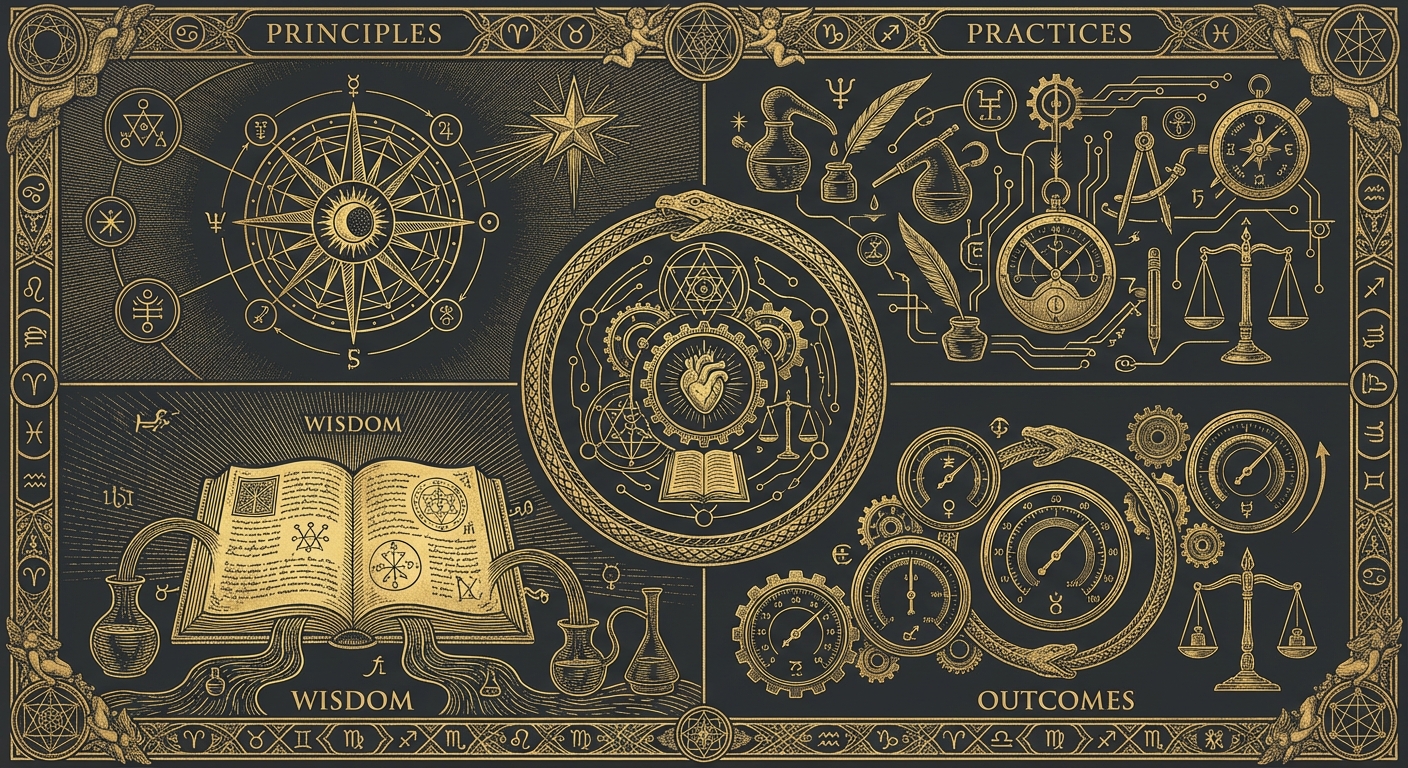
A discipline has:
- Foundational principles — Mental models that guide decisions
- Repeatable practices — Workflows that produce consistent results
- Accumulated wisdom — Patterns learned from experience
- Measurable outcomes — Ways to know if you're improving
Agentic design has all of these:
Principles:
- Declarative thinking (describe outcomes, not steps)
- Context economics (finite resources require curation)
- Human-agent partnership (complementary strengths)
- Continuous system evolution (improve over time)
Practices:
- Structured project setup (rules, references, commands)
- Plan-execute-validate cycles
- Context management and recovery
- Meta-prompting for prompt generation
Wisdom:
- When to involve AI versus do it yourself
- How to size work for AI effectiveness
- What context helps versus hurts
- How to debug when things go wrong
Outcomes:
- Faster delivery on security tasks
- Fewer AI-induced errors
- More consistent results
- Compounding improvement over time
Agentic Design vs. Agentic Engineering
There's an important distinction worth making:
| Agentic Design | Agentic Engineering |
|---|---|
| Using AI agents effectively | Building AI agents from scratch |
| Workflows, context management, commands | Agent architecture, tool implementation |
| Direct AI to solve your problems | Create new AI systems for others |
| Requires: Clear thinking, domain knowledge | Requires: Software engineering, AI frameworks |
| Time to productivity: Days | Time to productivity: Weeks/months |
Agentic design is the foundation. You learn to use agents masterfully before you learn to build them. Most practitioners will get extraordinary value from design skills alone—the engineering layer is for those who want to create entirely new agent systems.
This article focuses on design: the discipline of directing AI agents to amplify your existing capabilities.
The Skill Gap Is Real
Most people using AI coding assistants:
- Start conversations without context (the AI doesn't know the project)
- Give vague instructions ("make it better")
- Overload the context (dump everything hoping something helps)
- Don't systematize (every interaction starts from scratch)
- React instead of prevent (fix mistakes one by one)
This isn't criticism—it's the natural starting point. Nobody taught us how to do this.
But some practitioners have figured out systematic approaches. They have methods. They get consistent results. They ship faster while making fewer mistakes.
The difference isn't intelligence or experience. It's skill—learnable, transferable skill.
For Security Practitioners: Why This Changes Everything
If you're in security, agentic design isn't optional—it's becoming table stakes.
But let's be specific about what changes:
You become a builder, not just a user.
The tools you've been wishing existed? You can build them yourself now. Custom parsers for your specific log formats. Analyzers tailored to your environment. Detections that work exactly the way you need them to work. The barrier between "I wish this existed" and "I built this" collapses.
Your expertise gets amplified, not replaced.
Every year of security experience you have becomes more valuable, not less. The agent handles syntax and boilerplate. You provide the threat knowledge, the environmental context, the judgment calls. Your domain expertise is the foundation—agentic design multiplies everything you already know.
Repetitive work disappears into automation.
Alert triage workflows. Log analysis patterns. Report generation. Detection rule creation. These aren't things you do manually anymore—they're commands you invoke. What took hours becomes minutes. What took minutes becomes seconds. Your time shifts from execution to strategy.
You're fully empowered to create.
The barrier between idea and execution shrinks dramatically. You don't need permission, specialized training, or dedicated resources to start building. With agentic design skills, you prototype ideas in hours. You test hypotheses immediately. You solve your own problems instead of waiting for someone else to solve them for you.
The practitioners who master AI collaboration will outpace those who don't. Not because AI replaces security expertise, but because it multiplies it.
What This Looks Like in Practice
A practitioner with agentic design skills:
Sets up projects for AI collaboration:
- Structured rules that guide AI behavior
- Reference documents for detailed patterns
- Commands for repeatable workflows
Communicates effectively with agents:
- Declarative goals rather than procedural steps
- Appropriate context (not too little, not too much)
- Clear success criteria
Maintains quality:
- Reviews AI output critically
- Calibrates trust appropriately
- Catches errors before they compound
Improves over time:
- Evolves their system based on what works
- Captures patterns that emerge from experience
- Builds compounding advantage
Getting Started
The barrier to entry is low. You can start with whatever AI coding assistant you have access to—Claude Code, Cursor, Copilot—and begin shifting toward declarative communication today.
But here's the thing: starting is easy. Getting exceptional results is not.
There's significant nuance that separates practitioners getting decent results from those getting exceptional ones. The difference shows up in:
- How you structure context so the agent actually understands your codebase
- When to give the agent autonomy versus when to constrain it
- How to recover when things go wrong mid-task
- What patterns compound over time versus what's just clever tricks
You can figure this out through trial and error. Many do. But trial and error is slow, and the gap between "good enough" and "exceptional" is where the real leverage lives.
Structured learning compresses years of experimentation into weeks. The principles crystallize faster. The patterns stick. And you start building compounding advantage while others are still fumbling through the basics.
Key Takeaways
Agentic design is a new discipline — Emerging at the top of the abstraction stack.
No mathematical prerequisites — Clear thinking and domain knowledge are the requirements.
Skills stack with your career — Add to what you already do, don't replace it.
The gap between possible and typical is huge — Systematic approaches dramatically outperform ad hoc usage.
Now is the time to learn — Early practitioners build compounding advantage.
The question isn't whether AI agents will transform how we work. They already are. The question is whether you'll develop the skills to direct that transformation—or be directed by others who have.