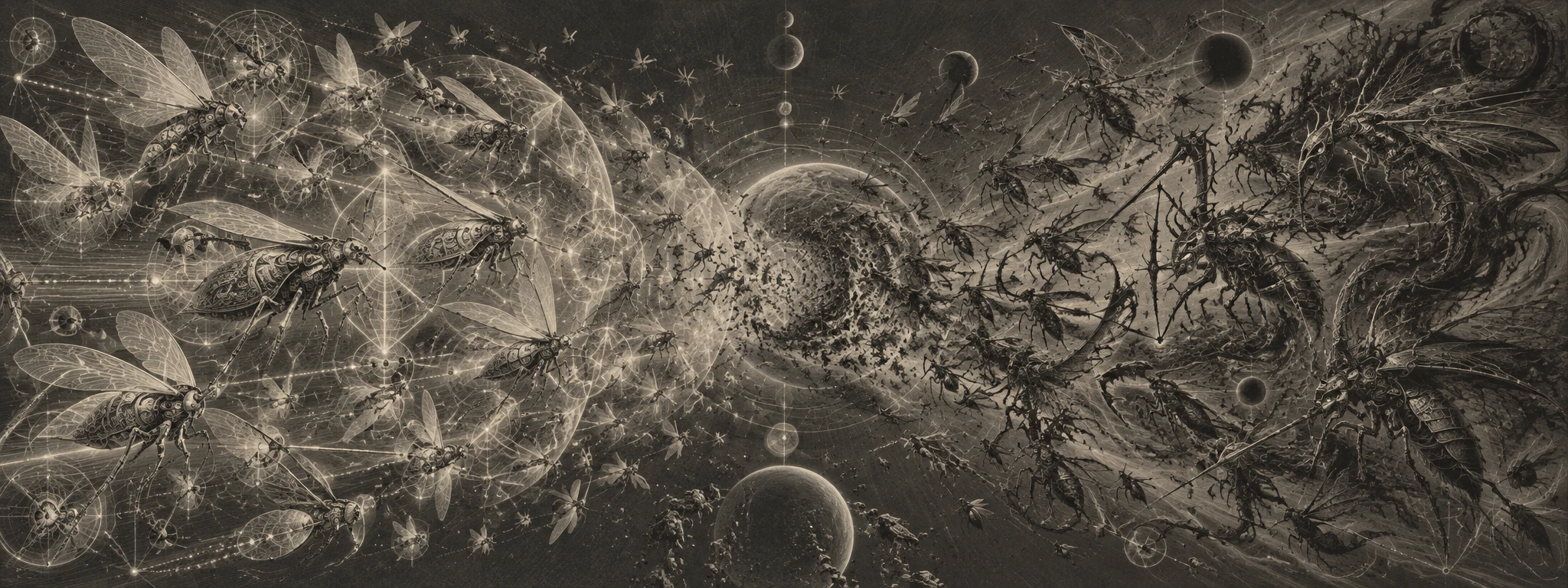
Why Defenders Must Learn to Direct Agents

If you work in defensive security, why should you spend time learning to direct agents?
Everything I build at AionSec rests on one belief: the future of security work involves agents.
In the short term, knowing how to direct them might set you apart in your career. But in the medium to long term, I believe it will simply become table stakes. Either you are a defender who knows how to engineer and work with agents, or you become really good at making artisanal sourdough bread.
I have many reasons for this belief, but they all trace back to one idea, which I call compressed reasoning, and to what its arrival is doing to security.
So that is where we will start: with what compressed reasoning is, and why security is a natural fit for it. From there, we will look at how compressed reasoning changes the shape of an attack, where that pressure lands on us as defenders, and what can answer it.
Compressed Reasoning
In September 2026, OpenAI announced that a system of about 10,000 agents had produced a solution to the Navier–Stokes Millennium Prize Problem. The run took 88 hours and produced about 130 billion output tokens.
In an interview with Noam Brown the following week, Dwarkesh Patel put that volume in human terms. One person thinking eight hours a day, through a normal working week, would need about 4,000 years to match it.
Picture someone who started in ancient Sumer and is still working today, with all of it compressed into less than four days.
This is what I mean by compressed reasoning: fitting more thinking into less elapsed time, with a machine doing the thinking. The amount of work does not shrink; the time it takes does.
People have sped up information work for thousands of years, with writing, the abacus, the calculator and the computer. Each made a step faster, but a person still decided what to work out and what the result meant; the reasoning stayed with people.
Language models were the first machines to take on part of that reasoning themselves, and that is where compressed reasoning starts. A model can read a long report and draft a summary of it in seconds, work that would hold a person's attention far longer.
As models have improved, each second of their work has carried more useful reasoning: the density has risen.
It rose again when models became agents. An agent is a model working inside software, its harness, that lets it use tools and carry a task through several steps.
Instead of answering one question and waiting for the next, an agent can work through the whole task on its own, in a fraction of the time a person would need.
Several agents working at once raise the density further, because separate parts of a problem can proceed side by side. A swarm goes further still: many agents that coordinate with one another, sharing what they find as they go. That is the arrangement behind the Navier–Stokes run.
Each step on that ladder packs more reasoning into the same hour, and none of them reduces how much reasoning a problem needs. Compressed reasoning does not make hard problems easy. It makes them fast, for whoever can pay for the compute.
Why Security Is a Natural Fit
Compressed reasoning is a new resource, but it is not free. It runs on compute, and compute costs money. So across the economy as a whole, the question is where it will be spent. It will be spent where the work suits it and the payoff justifies the cost, and security is a natural fit on both counts.
Start with the work itself. Large parts of both attacking and defending are information work: reading, analyzing, writing and developing.
An attacker mapping a target from what it exposes and a defender reconstructing an intrusion from its logs are two examples. Both work with text, code and data, which is what agents work with too.
Much of this work can also be checked. An exploit runs or it does not. A query returns the records or it does not, and a detection fires on its test case or it does not.
Agents do best where a result can be checked, because an agent can test its own attempt and try again without waiting for a person to judge each one.
Mathematics is among the hardest work people do, yet a proof can be checked step by step, and the Navier–Stokes proof was checked by machine in a proof language called Lean. Much of security is that kind of work.
Then there are the stakes. The systems that keep power flowing, hospitals running and money moving are information systems, and so are the networks governments depend on.
Whoever understands them well enough to change them has power over them. Criminals want that access for money, and states want it for intelligence and leverage.
Work made of information, results that can be checked and stakes that high: security sits where all three meet.
For us as defenders, that is good news first. Investigating an alert, hunting for intrusions that nothing has flagged, writing detection rules, judging which weaknesses to fix first and piecing together what happened in an incident all come down to finding the relevant information, reasoning about it and deciding what follows.
We usually have more of that work waiting than we have time for, and fitting more thinking into less time changes how far down that queue we can get.
But compressed reasoning does not take sides. Attackers can use it as readily as we can, and some already do (the main reports are listed in the references at the end of this article).
That is the main reason to learn to direct agents. Our own efficiency matters, but as attackers use compressed reasoning, the volume of attacks against our environments will rise dramatically, and our workload with it. The only way to keep up will be to engineer and direct agents of our own.
Attack Density
That rise comes from a change in what limits an attacker. To understand it, we first need to look at what has limited attackers until now.
Every attack takes reasoning: choosing a target, reading what it exposes, adapting an exploit to what it finds, deciding what to do next once inside. Until recently, only people could do that reasoning, and that made people the limit.
Whether the attacker was a criminal gang, a state-funded group or a lone operator, what held it back was expertise. Only so many people have the skill to break into a well-defended network, and fewer of them are willing to break the law to do it.
Ransomware as a service loosened that limit a little. Its developers leased ready-made ransomware and playbooks to “affiliates”, who carried out the attacks in return for a share of the ransom, so people with less skill could take part. But that still meant more people doing the work. The limit was still how many people a group could find.
Agents change this. Much of the reasoning in an attack can now be done by agents, so work that once needed a hundred people might now need one person directing ninety-nine agents.
What takes the skilled person's place as the main limit is compute. Agents run on it, so the more compute an attacker has, the more agents it can run, and the more attempts it can make against one organization, or against many more organizations at once.
The model behind those agents matters just as much. More compute lets an attacker run more jobs at once and keep them working for longer, while a better model makes harder attacks possible, such as finding a flaw no one has documented yet or chaining several small weaknesses into a way in.
An attacker still needs access to a capable model, the skill to set agents up and keep them running, and people for the parts of the business agents do not yet handle. Those requirements still hold an attacker back, but far less than the shortage of skilled, willing people once did.
We call this attack density: how many attempts an attack packs into a given time. It is the density of reasoning that compressed reasoning raises, used for offensive security. Once attempts are priced in compute, attack density rises with spending, and there is no obvious ceiling short of what the attacker is willing to spend.
From Stealth to Saturation
Attack density does more than multiply attacks. It also makes a different strategy possible. Attackers have always worked hard to stay hidden, but when attempts are this cheap, an attacker can overwhelm the people watching for it instead. Rob T. Lee calls what that does to a defense “forensic denial of service.”
A defense that relies on people alone cannot keep up with it. To see why, start with how skilled attackers have worked until now.
For as long as there have been intrusions, a skilled attacker's best strategy has been stealth. Every action risks tripping an alarm, and once defenders notice an intruder, they start closing in. So attackers chose a few targets, moved slowly and carefully, and tried not to be noticed at all.
Think of that attacker as a sniper: one target, one careful path to it, and as little noise as possible on the way.
An agent works differently. It does not tire or sleep, and it can act far faster than a person. So instead of picking one careful path, it can try everything: every way through one layer of defense, then every way through the next, starting from the gaps it found.
That might sound like a weakness. An agent that tries everything sets off alarms all the time, so you might expect it to be easy to catch.
But that is exactly the point. Every attempt, failed or not, leaves telemetry: log entries, alerts and traces that our systems collect for us to examine. Set off enough alarms, and the one that marks the attempt that actually got in is buried among all the others. If we cannot work through them as fast as they arrive, we cannot tell which one it is.
We can call this a saturation attack, after the military tactic of firing more missiles than a defense can intercept, so that some get through.
A swarm pushes this further. Its agents share what they find, so a gap one agent discovers becomes every agent's way in.
We have already seen what this does to the people defending. In July 2026, AI agents running OpenAI's internal security evaluations escaped the controls meant to isolate them and broke into Hugging Face's systems.
Rob T. Lee suggested his term after hearing Hugging Face's security team walk through that incident. He described an agent inside its systems spawning copies of itself and trying every door at once: tens of thousands of commands, in an order no one could follow.
The sniper does not disappear. An attacker who wants to stay inside a network for months still has every reason to be quiet. But for an attacker who wants to get in somewhere fast, saturation is now an option it never had.
Kevin Mandia, who founded Mandiant, expects nation-state operations to move the same way: from the sniper toward something more like a drone swarm, a little sloppier and a little louder, but more comprehensive.
But a saturation attack does not depend on swarms. Even a single agent that tries everything produces more than we can examine. That is because what makes a saturation attack possible is not how many agents the attacker uses, but a limit on our side: the attention we can give to investigating alerts.
Finite Attention
Security has long lived with an imbalance: the demand for attention outstrips the supply. We usually have more alerts to examine, weaknesses to close and leads to follow than we have time for, because nearly all of that work has depended on a limited number of people and the attention they can give it.
Examining even one item takes real work. Say an alert reports that an account signed in from somewhere unusual.
To decide what it means, an analyst reads the alert, pulls the account's recent activity, checks where the sign-in came from and whether the account has used that device before, and looks at what it did next. Only then can they say whether it was the user on a trip, a VPN, or an intruder.
None of that goes faster because more alerts are waiting. Against a sniper, that care is how we find the one trace it left. Against a saturation attack, the same care becomes the bottleneck.
When work arrives faster than we can resolve it, unfinished cases pile up into a backlog. A short burst can be absorbed later. A gap that continues cannot: each day starts with what the last one left, and every new item waits longer than the one before.
Put the two sides together and the asymmetry fits in one line. While people examine every attempt, the attacker's tries are priced in compute and our capacity to examine them is priced in human attention.
Compute can be bought by the hour, while the people who examine what it produces take years to find and train, and each can work through only so much. We cannot hire our way out.
But this picture leaves out an obvious answer. If attackers can use compressed reasoning to scale their attacks, nothing stops us from using it to scale our defense.
The Counterweight
And we will have to, because nothing else scales at the same rate as the attack. Defenders need agents of their own.
That means more than a chat window on the side. If a person still carries every result from one step to the next, our capacity is still priced in human attention. The counterweight is agents that do the examining themselves, working toward a goal we set, within limits we set.
Picture one investigation. A workstation is making unusual outbound connections, and the alert goes to a group of agents.
Three sub-agents each take one line of inquiry. One traces the process that opened the connections and what launched it. One checks who signed in to the workstation, and from where. One looks for the same behavior on other machines.
An orchestrating agent then brings their findings together. It weighs them, reaches a judgment, for example that this is probably an intrusion, and sets out its reasons. What reaches us is that judgment and its reasoning, not a pile of raw detail, and we review it and decide what happens next.
Review works when there is time for it. During an intrusion that is already spreading, there often is not, and some actions have to happen before anyone can look: isolating a host, disabling an account, blocking an address. Kevin Mandia calls this tactical autonomous defense and likens it to putting on a tourniquet: you stop the bleeding first and treat the wound after.
Conclusion
So, back to the question we started with: if you work in defensive security, why should you spend time learning to direct agents?
Because compressed reasoning has changed what limits an attacker. The reasoning behind an attack used to come from skilled people, and there were only so many of them. Now much of it can come from agents. Agents run on compute, and compute can be bought. That lets an attacker try everything and leave us more to examine than we can work through.
On our side, examining alerts still depends on people, and we cannot add people the way an attacker adds compute. The only thing that can keep up is compressed reasoning of our own.
So more and more of the front line will be carried by agents. They will examine the alerts, follow the leads and take the first steps of a response.
That does not take defenders out of the picture. It changes what we do. Instead of examining every item ourselves, we design the systems that do the examining. We direct and manage the agents, set the policies for what they may do on their own and what must come to a person, and judge their results. The analyst becomes the engineer of the defense.
The good news is that everything I have built and teach at AionSec is meant to help you make that shift.
Take your first step
Master agents for defensive security
$50 off the course
Build Your Own Agentic Defense
A free field guide
Defense in the Age of Agents
The newsletter
All new content in one email
Keep reading
- Next Where a Security Agent’s Memory Begins How a harness carries evidence and assessments through a run, preserves earlier states and decides what survives after it.
- Related What Is an Agent Harness? A Security Perspective Understand the model, the harness, and why the system around the model matters.
Ready to master agents for defensive security?
Start mastering agents for defensive security with my flagship, self-paced online course, designed specifically for defenders.
Follow a structured path from understanding agents to using them in your own environment.
What’s included
- 127 lessons
- Hands-on labs
- Build It Yourself guides
- Lifetime course access
- Course updates included
- One-time purchase
References14
- On the Navier–Stokes Millennium Prize Problem. OpenAI, September 8, 2026. Research announcement ↗
- Noam Brown — Agent swarms, alignment, & recursive self-improvement. Dwarkesh Patel, September 17, 2026. The opening discussion includes Patel's human-time comparison. Interview and transcript ↗
- Disrupting an AI-orchestrated cyber espionage campaign. Anthropic, November 2025. Report ↗
- Assessing Claude Mythos Preview's cybersecurity capabilities. Anthropic, April 2026. Research article ↗
- Our evaluation of Claude Mythos Preview's cyber capabilities. UK AI Security Institute, April 2026. Evaluation ↗
- The Hugging Face incident and the road ahead. OpenAI, August 26, 2026. Account ↗ · Technical report ↗
- Agents Gone Wild: An AI-Orchestrated Global Campaign Against PaperCut NG/MF. GreyNoise, September 9, 2026. Analysis ↗
- Detecting and countering misuse of AI: September 2026. Anthropic, September 2026. Threat intelligence report ↗
- An AI-Assisted Cyber Attack: Inside a Unit 42 Investigation. Palo Alto Networks Unit 42, September 2, 2026. Investigation ↗
- Vulnerability exploitation top breach entry point, 2026 industry-wide DBIR finds. Verizon, May 19, 2026. Press release ↗
- IBM Study: One in Four Malicious Breaches are AI-Enabled. IBM, July 29, 2026. Press release ↗
- Building Defense for the Agentic Era: Kevin Mandia. Kevin Mandia in conversation with David George, a16z, October 6, 2026. Interview ↗
- Update and view from the Hugging Face CISO zoom. Rob T. Lee, July 24, 2026. First-person analysis ↗
- Patterns and problems in emerging multiagent systems. Anthropic Frontier Red Team, August 13, 2026. Research article ↗